Once you understand the basic principles of robotics, the next step is learning how to build robots that are stable, reliable, and consistent. In WRO, mechanical design often matters more than students expect. I’ve seen many robots with good programs fail simply because something in the structure shifts slightly between runs.
Most WRO robots are built using LEGO EV3 or similar systems. While the parts are simple, the difference between a weak robot and a strong one comes down to how those parts are put together.
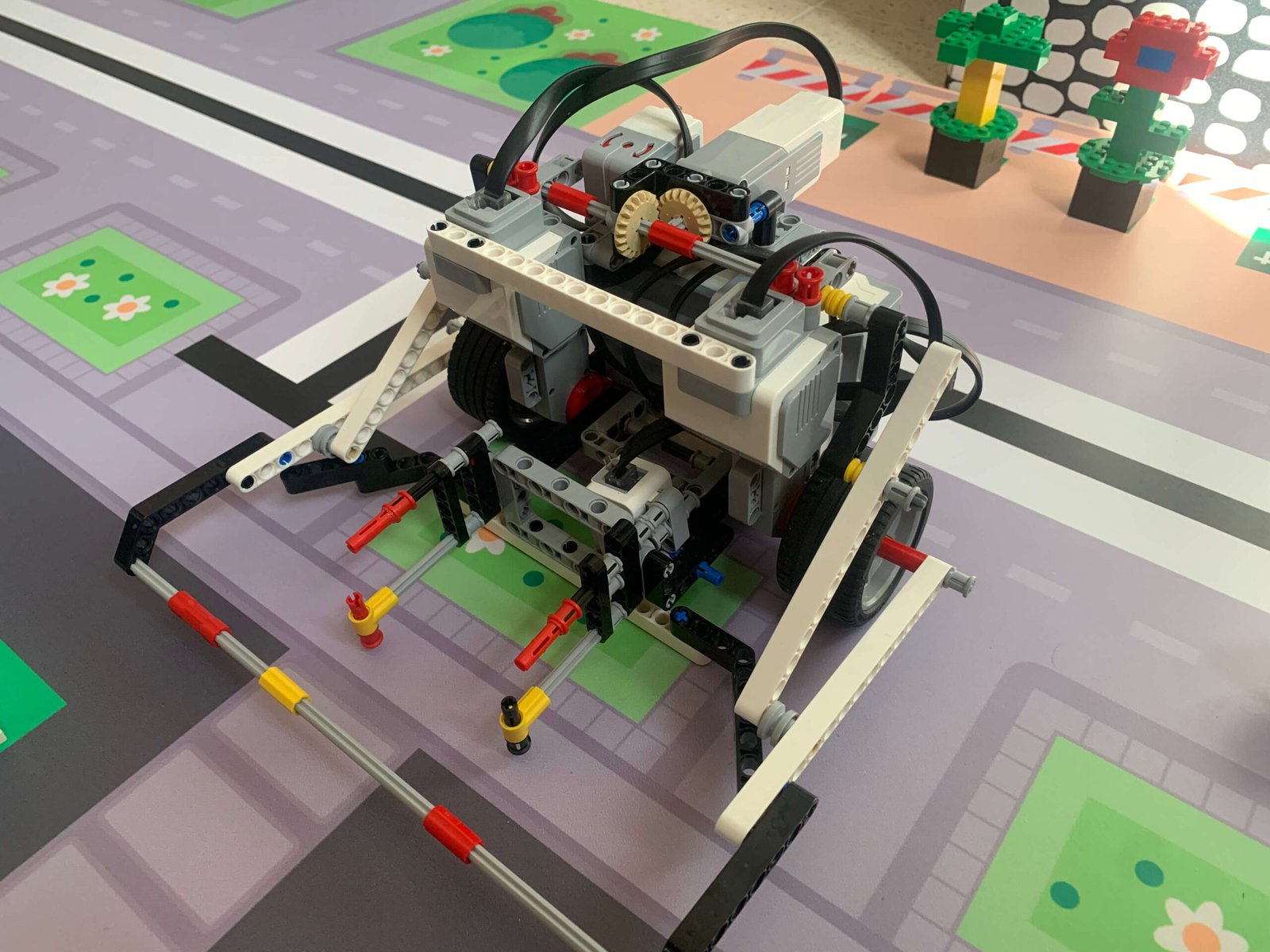
One of the first ideas I emphasize is that simplicity and rigidity matter more than complexity. The best robots are usually compact and extremely solid. This is because WRO is not about doing something once — it’s about doing the same thing repeatedly, with as little variation as possible.
Because of this, structural rigidity becomes critical. A rule I always give students is:
when you connect two parts, aim for at least two points of contact — and ideally more.
If you only use a single pin or connection point, the part can rotate or loosen over time. This often leads to subtle errors that are hard to debug. For example, a slightly rotating beam might shift a sensor just enough to break line following.
To make structures stronger, students should avoid long unsupported beams and instead build closed shapes, such as rectangles or triangles. These distribute forces much better and prevent bending. Using frames, layering beams, and connecting from multiple directions all help create a robot that behaves consistently.
A good place to start any robot is with a drive base. I recommend that students build this first and treat it as the foundation of everything else. A drive base is simply a robot that can move reliably, without any attachments.
Getting this right early saves a lot of time later.
When building a drive base, one of the most important goals is to keep the center of mass as low as possible. A low center of mass makes the robot more stable, reduces wobbling during turns, and helps ensure that the wheels stay firmly in contact with the ground.
A very practical way to achieve this is by placing the heaviest components — especially the EV3 brick — as low and as close to the wheels as possible. Many students initially mount the brick high up or far from the center, which makes the robot less stable and harder to control.
Weight distribution is closely related to this. Ideally, most of the robot’s weight should be centered over the drive wheels. This maximizes traction, which improves both straight-line movement and turning accuracy. If the weight is too far forward or backward, one set of wheels may lose grip slightly, leading to inconsistent movement.
Most WRO robots use a two-motor differential drive, where one motor controls each wheel. This setup is simple and very effective. By varying the speed of each motor, the robot can move forward, turn smoothly, or rotate in place.
To support the robot, a third point of contact is usually added using a caster wheel or skid. Here, the key idea is to minimize friction. If the support creates too much resistance, especially during turns, it will reduce accuracy. A small, smooth contact point usually works best.
Another thing I encourage students to think about while building the drive base is future expansion. Even at this stage, it’s helpful to leave strong connection points on the structure where attachments can be added later. This avoids having to rebuild the robot when new mechanisms are introduced.
Sensor placement is another area where small details make a big difference. Sensors should always be mounted as rigidly as possible, with no wobble or movement.
One practical method is to:
For example, when mounting a color sensor for line following, it is important to keep the distance to the mat consistent. If the sensor moves up and down even slightly, the readings can change enough to break the program. A rigid, low-mounted sensor structure usually works best.
As robots become more advanced, students will begin adding mechanisms to interact with objects on the field. At this stage, it is important to remember that reliability matters far more than complexity. A simple mechanism that works every time is much more valuable than a complicated one that only works inconsistently.
I highly recommend building the game pieces before starting to design the robot. This allows students to test directly with real objects and design mechanisms that can handle slight variations in size, position, and alignment. It also helps ensure that mechanisms are general-purpose, rather than only working in one very specific setup.
This is especially important because, excluding the two motors used for driving, teams only have two additional motors for all attachments. This means each mechanism often needs to perform multiple tasks, rather than being designed for just one.
When I participated in the WRO final in Turkey, I saw many top teams take this even further by using gear combinations and mechanical linkages to allow a single motor to operate multiple mechanisms.
Finally, building robots is always an iterative process. No design works perfectly on the first attempt. The real progress comes from testing, identifying weaknesses, and improving the design step by step.
I’ve found that the most successful students are not the ones who build the most complex robots, but the ones who test frequently and refine small details. Small improvements in rigidity, alignment, or weight distribution can lead to large improvements in performance.
For this reason, testing should be treated as part of the building process, not something that happens after. The best robots are not just well-designed — they are well-tested and carefully refined.
In the next module, we will look at sensors in detail, and how they allow robots to interact with the competition field in a controlled and reliable way.